
Free Delivery  ·  COD Available  ·  15-Day Returns
Pricio
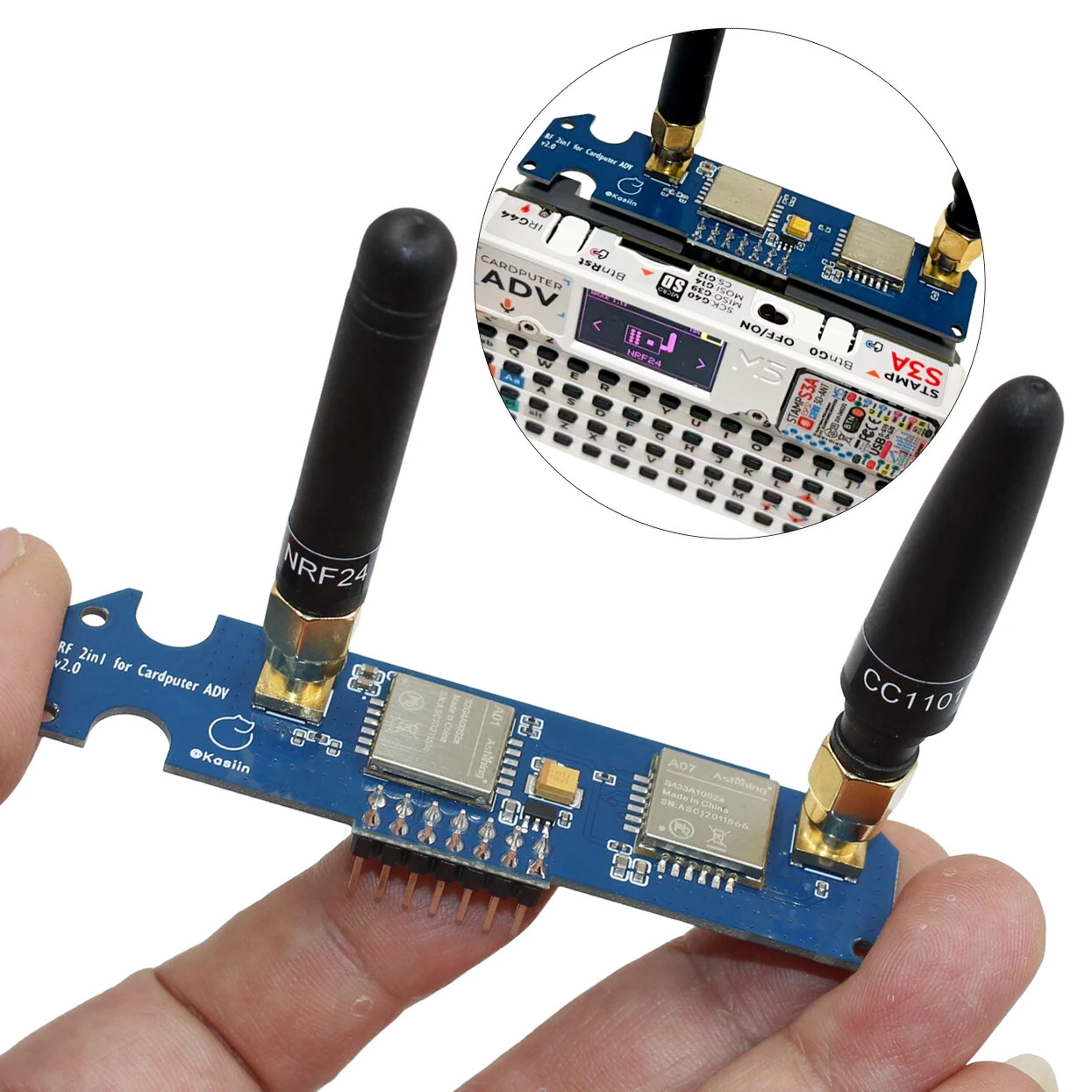
M5Stack Cardputer ADV Dual RF Module CC1101 NRF24 SubGHz 24GHz Wireless Signal Transceiver Compatible with Bruce Firmware — image 1
Hover to zoom

1 / 5 · Click to enlarge

M5Stack Cardputer ADV Dual RF Module CC1101 NRF24 SubGHz 24GHz Wireless Signal Transceiver Compatible with Bruce Firmware

5.01 rating
599+ bought in last month
AI Summary
product for everyday users

The M5Stack Cardputer ADV Dual RF Module CC1101 NRF24 SubGHz 24GHz Wireless Signal Transceiver Compatible with Bruce Firmware is a mid-range product designed for everyday users.

wireless convenience
₹3,424-27%
MRP:₹4,699Save ₹1,275
Free Shipping💵 COD Available

Available Offers

Free Delivery on this order. No minimum order value.

15-Day Easy Returns — hassle-free return & full refund.

Secure Payment — 100% safe checkout with UPI, Cards & Net Banking.

27% Off — you save ₹1,275 on this product!

Color: Blue

Blue
Total: ₹3,424
Buying tip: A quality investment for dependable performance and premium build quality.
Estimated delivery: 26 Aug9 Sept
Free Shipping
Pan India delivery
15-Day Returns
Hassle-free policy
Secure Payment
Razorpay protected
Quality Assured
Vetted products only

Available Offers

💳

5% Cashback

Pay with UPI & get 5% cashback (up to ₹50) via Razorpay

🏦

No-Cost EMI

Available on select bank cards at checkout. 0% interest for 3 months.

📦

Free Shipping

Free delivery on all orders. No minimum order value.

💵

Cash on Delivery

COD available on orders up to ₹5,000 across India.

Ideal For

Everyday convenience
Share:
SKU: bg-2044975

About This Product

The M5Stack Cardputer ADV Dual RF Module CC1101 NRF24 SubGHz 24GHz Wireless Signal Transceiver Compatible with Bruce Firmware is a mid-range designed for everyday users. It delivers reliable performance at an accessible price.

Why Buy from Pricio?

Pricio sources this product directly, cutting out multiple middlemen. Every order includes free shipping, a 15-day return policy, and secure payment via Razorpay.


Update notification: Starting in February 2026, the manual version will be upgraded to an automatic version, which resolves the issue of weak interference in the switch-based version.

Specifications:
RF Module Type: Dual RF Module (CC1101 and NRF24)
Supported Frequency Band: Sub-GHz and 2.4 GHz
NRF24 Functionality: NRF24 jammer (effective on 2.4 GHz WiFi; limited effect on Bluetooth-based devices)
CC1101 Functionality: Sub-GHz signal transmission and reception
Hardware Compatibility: Compatible with Bruce firmware
Antennas: Includes 2 external antennas for optimal performance

Features:
1. Dual RF Module Integration: Combines CC1101 and NRF24 modules in one compact device, providing versatile wireless communication and frequency support in a single unit.
2. Efficient Sub-GHz Coverage: Equipped with CC1101 to handle Sub-GHz signal reception and transmission, ensuring reliable communication across a broad application spectrum.
3. Targeted NRF24 Jammer Performance: Designed for 2.4 GHz WiFi interruption with focused efficiency, making it effective in short-range disruption scenarios.
4. Firmware Compatibility: Fully compatible with Bruce firmware, ensuring seamless integration for advanced configurations and network experiments.
5. Compact Design with Antennas: Includes two external antennas to maximize signal transmission and reception, while maintaining portability and ease of use.

Package Included:
1 x RF Module (CC1101 + NRF24 combo)
2 x Antennas
(The M5Stack Cardputer ADV is not includes, for reference only)


Product Safety Information

Setup Guide

1
Identify the pins
Locate VCC (power), GND (ground), and data pins (SDA/SCL for I2C, MOSI/MISO for SPI, or TX/RX for UART). Refer to the pinout diagram on the product page.
2
Wire to your microcontroller
Connect VCC to 3.3V or 5V (check the module spec), GND to GND, and data pins to the appropriate GPIO pins on your Arduino or Raspberry Pi.
3
Install libraries
In Arduino IDE, go to Sketch → Include Library → Manage Libraries and search for the sensor library. Install the recommended version.
4
Upload example sketch
Open File → Examples → [library name] → Basic Example. Upload to your board and open Serial Monitor to view output.
5
Calibrate if needed
Some sensors (temperature, humidity, distance) may need a short warm-up period or calibration. Run the calibration sketch if provided.